Music
A few years ago I got into Critical Role, a Twitch stream where a cast of voice actors play Dungeons and Dragons. I probably don’t have to explain DnD (or CR) to anyone reading this, but on the off chance that you have escaped this particular aspect of nerd culture: DnD is a tabletop role-playing game where players pretend to be characters in a fantasy setting, going on adventures and quests, occasionally exploring the eponymous dungeons and often fighting the eponymous dragons. While there had been media based on DnD before (including a fondly-remembered cartoon from the 80s), Critical Role was an early example of the “actual play” genre, where the show itself was a (relatively unedited) video of players simply playing the game. It’s very nerdy, a little goofy, and a lot of fun to watch: the cast have excellent chemistry and genuine voice acting chops. I started watching in 2020, when I (along with everyone else) suddenly needed some comforting, escapist media to fill the long days; since then, CR has grown into a budding media empire, with millions of weekly viewers and multiple spin-off TV shows.
A Typical DnD Group
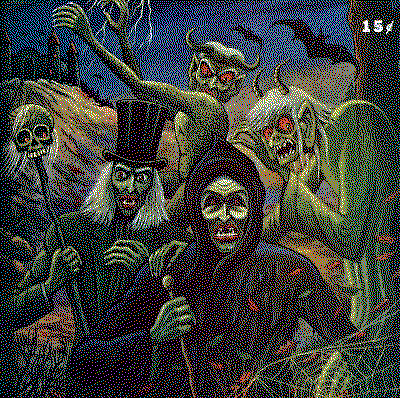
From Critical Role, my interest branched out into TTRPGs in general. I listened to other actual play podcasts (like Critical Bits), I read too-long wiki entries on obscure lore, and I started to cultivate an aspiration to maybe, sometime, perhaps, play DnD myself. However, while I liked the idea of playing DnD—I loved the escapism of Critical Role, and I loved the idea of collaboratively developing an intricate and long-running story with my friends—the actual practicalities of playing were a little daunting. Whatever way I looked at it, a session of DnD was fundamentally going to involve me and my adult friends sitting around a table, doing funny voices, and pretending to be goblins or elves or whatever. In the end, I let my fear of cringe get the better of me, and for years I didn’t take any proactive steps to set up a game.
My interest was rekindled a couple of years ago, when I started playing Baldur’s Gate 3. A little after that I saw the Quinn’s Quest review of Mothership (a sci-fi TTRPG), and I finally bit the bullet and bought the system, and decided to run the game myself for some of my friends. Since then, I’ve run a handful of games (not DnD, but more on that later) for my friends, and I’m really happy that I managed to suppress my innate fear of cringe and just try it, because it’s been a really rewarding and fulfilling hobby.
I think that my experience as a Critical Role viewer—getting really into the show, getting immersed in the lore and wider hobby, but not taking the last step to actually set up a game myself—is a pretty common one. This post is about TTRPGs, Mothership, and a homebrew scenario that I’ve run a few times; my hope is that it might push someone out there to actually get playing, and start a game with their friends. Alternatively, if you know me in real life, and you’re looking for players, or looking to play, get in touch!
Typical Mothership Player

Mothership
As mentioned above, I was initially enticed into playing Mothership by the excellent Quinn’s Quest YouTube channel, which gave Mothership a glowing review. While the review emphasised the excellent ecosystem of third-party modules available for the game, I was initially attracted to the game’s theming, simplicity, and the “OSR” play style that it encouraged.
Theming
Mothership is often sold as “Alien meets Event Horizon”, but to be honest that undersells how much the base game feels like “Alien the RPG”. The cassette-futuristic technology of the setting feels right out of the Nostromo, the four base classes in the game are clear references to characters from the films, and the introductory module for the game (“Another Bug Hunt”) is an on-the-nose homage to Aliens (the scenario’s title comes directly from a line in the film).
I should stress that I don’t think any of this is a bad thing! I wouldn’t describe anything in Mothership as “derivative”; reading the material in the core set, I was struck by how innovative and fresh it all felt. However, it can be a little confusing to describe the game to new people, considering that an officially-licensed Alien RPG already exists.
Beyond the clear Alien influence, Mothership does pull in some more occult-magic-style horror, and visually the core set seems to take a lot from the Manga BLAME!. Where the theming can get diverse, however, is in the third-party modules. There is a space-slasher on an abandoned party-planet, a space-western, and an existential/psychological horror AI-bodysnatcher megadungeon.
Over the past year, Mothership has been the main RPG that I have played, so I’m a little spaced-out at the moment, and the setting doesn’t hold as much spark for me as it used to. That said, I don’t think it would take much to get back into it: a little synthwave, a creepy plot hook with cyberpunk elements, and I’m sure I would be right back on Prospero’s Dream, ready to orchestrate a cyber-heist for space-diamonds. Overall, I did really like Mothership’s setting: it’s evocative, with a lot of scope to tell stories from cyberpunk political intrigues to cosmic horror.
Simplicity
Required Equipment
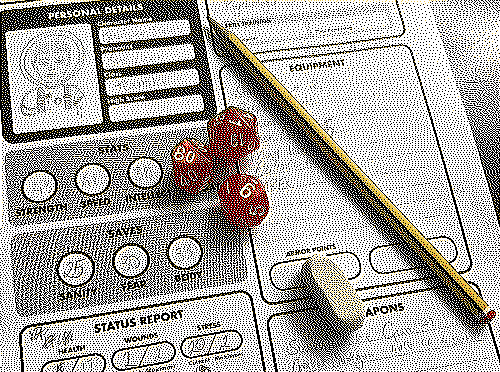
The largest factor that actually pushed me to buy the Mothership core set was its simplicity. Even putting the extensive lore aside, Dungeons and Dragons, as a system, is complex. I’m not ashamed to say that I was intimidated by the amount of rules in DnD, and even after watching hundreds of hours of actual-plays I still felt that I didn’t really have a good sense of the full mechanics of the game.
Mothership, by contrast, has a rules system that can basically fit on a couple of A4 pages (or just one, if you’re being especially frugal), and it takes maybe ten minutes to teach. This makes it a great system for first-time DMs (like me). Another benefit of the simplicity is that character creation also takes about ten minutes, which is especially handy in light of the game’s high lethality. Lots of modules and scenarios expect multiple player character deaths per session, so it’s nice to be able to get a player right back into the action quickly with a new character.
OSR
As with any good niche hobby, the world of TTRPGs has a variety of different styles and sub-communities within the hobby itself. And, as with any good niche hobby on the internet, those differing styles and schools often develop into factions and holy wars.
Mothership is an “OSR” style game, where OSR stands for “old school renaissance” or “old school revival”; it’s a style of play inspired partially by 1970s RPGs (including 1st edition DnD). As with any “revival” movement, it’s debatable to what degree modern OSR games can claim a lineage with those 1970s games, and to what extent they’re actually a new thing entirely, but that’s the kind of debate I don’t find particularly interesting.
What I do find interesting, though, is the philosophy of the OSR itself, and how it contrasts with games like modern DnD. While reading about OSR games (like Mothership, but also MÖRK BORG), I found myself nodding in agreement, and I found remedies to aspects of DnD that had vaguely rubbed me the wrong way.
So, if you’ll indulge me (you have to: it’s my blog), I wanted to write a little about some of the things I don’t like about DnD, and how OSR games differ. You should take all of this with a huge grain of salt, though, since I have only actually played a handful of RPGs, and DnD is not among them! Also, the two DnD actual-plays I have watched extensively are Critical Role and Dimension 20, and I think that both Matt Mercer and Brendan Lee Mulligan are virtuosic DMs. Really, the more I’ve played, the more I understand the depth of their skill. So the criticism I have here should be understood in the context of overall admiration for those shows. Also, despite what these next few bits might suggest, I do really like DnD! I think it’s a very fun game, and it is generally quite well designed, especially considering all of the different conflicting goals it has (be friendly to beginners, be similar and recognisable to veterans, facilitate the disparate kinds of games people want to play, be incredibly varied but coherent, be “balanced”, etc.).
Death
One of the most visible differences between DnD (5e) and OSR-style games is lethality: in DnD, player character death is rare. This is perhaps surprising, considering the amount of extreme violence the average adventuring party gets up to, but what bothers me isn’t necessarily the lack of realism, it’s the lack of death as a storytelling tool. I understand that this is partially my own taste: I don’t like happily-ever-afters, and some of my favourite moments from movies and TV are character deaths (the end of season 1 of Game of Thrones! Either of the heartbreaking deaths in Fellowship of the Ring! (the best Lord of the Rings movie)). However, personal taste aside, I do think that lots of stories are improved by the inclusion of tragedy, and I do think a lot of stories told through DnD are lesser because the system avoids this outcome so much.
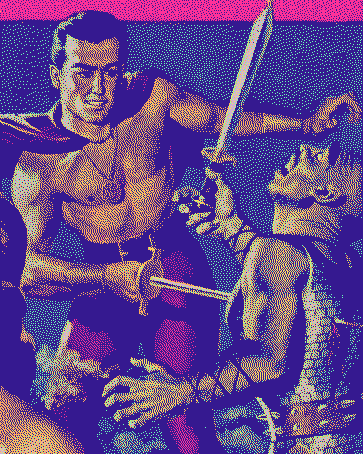
Pictured: left, a DnD player having a good time. Right: a DnD player also having a good time.
A TTRPG has a difficult line to walk, because although the high-level goal is to tell a compelling story, the moment-to-moment gameplay usually involves players pursuing goals that are much more in line with their characters’ goals, and often those two goals come in conflict. When a player is one hour deep into a four-hour combat session, all that player (and the DM, usually) wants is for the PC to win the fight; what both people should remember, however, is that failure can be just as interesting and compelling an outcome as success, and that success is only satisfying if failure was really an option. It’s important, then, to avoid the temptation to go easy, or fudge rolls, because it will make the game less fun in the long run.
This tension between goals will be present in any TTRPG, but (to my taste) DnD’s balance leans too heavily in favour of giving the player what their character wants, to the detriment of what the story wants, especially when it comes to character death. Part of this is because players expect a certain structure to a DnD campaign: it’s usually zero-to-hero, told over 10+ sessions, over the course of months or years. The system is designed to facilitate that kind of play, which is fine! It can be very rewarding to follow a character through a long arc of development. However, the negative effects are clear: in the small scale, the rarity of death takes a lot of the feeling of danger out of combat; at best, I find that DnD combat feels merely challenging, and at worst, it can feel like a grind. In the larger scale, it can rob the story as a whole of stakes, and of the kind of memorable moments that stick with you because they were upsetting at the time. My favourite season of Dimension 20 (by far) was A Crown Of Candy, the only season I have watched which allowed early player-character perma-death. Dimension 20 always had excellent world-building, and compelling characters; this season differed from the others in that I found myself getting more engrossed in the story as it proceeded, because the stakes felt like they were getting genuinely higher. It was also the only season where I found combat just as enjoyable to watch as the out-of-combat episodes.
Video Games
Since DMing myself, I’ve realised the biggest part of the DnD system that I dislike is actually how it can sometimes feel video-gamey. In particular, it can feel like a mass-market AAA video game, with a big focus on numerical stat increases and loot as rewards. Video games that lean on that kind of mechanic to improve player retention are now often derided as “Skinner boxes”, but I feel like the same negative aspects of these kinds of rewards can show up in TTRPGs as well.
Again, I want to be clear that this kind of thing can be a lot of fun. Your character getting a new sword is cool, and sometimes the easiest way for a DM to reward a win is giving out some loot or bumping a stat.
However, I can’t shake the sense that it’s a little cheap, as a mechanic. Whenever I have noticed myself doing something in a video game that feels like grinding for a stat improvement, I make a conscious effort to re-evaluate if I’m actually having fun, or if I’m just a little addicted.
Both the rarity of character death and the primacy of mechanical stat-based progression seem to me to be designed to make it easier to run the “ideal” DnD campaign. For example: players want to tell long stories? Make it harder for player characters to die. Players want to see character progression and development? Well, one easy way to simulate that is through mechanical progression, so let’s facilitate that as much as possible.
In this way, the OSR as a contrast to modern DnD reminds me a little of the way that Dark Souls games are often seen as a reaction to modern AAA bloat. By returning to the conventions of older, cruftier games, by removing the affordances that were supposed to enhance narrative, we’ve rediscovered a leaner, meaner system that ends up being more narratively satisfying. (I realise I have now basically written “Mothership is the Dark Souls of RPGs”, but this is my personal blog, so I’m allowed to be trite.)
Rolling Dice
One of the big tenets of the OSR is the idea that dice rolls should be used sparingly. There are two aspects to this, as far as I can tell. First, it’s important that the GM only calls for a roll when all outcomes of that roll are interesting, and push the story forward.
Take, for example, the following situation: it’s the beginning of a campaign, and the players are investigating the office of a missing merchant (presumed kidnapped). Hidden in a secret drawer of the merchant’s desk is an enigmatic note full of tantalising leads, plot-thickening revelations, and hints of a conspiracy that goes right to the heart of the government!
Except that the players all fail their investigation check, so they don’t find the secret drawer. Now they have no leads, and nothing to do, so the plot grinds to a halt, while the DM scrambles to try and figure out how to give them the note anyway. Oops. Now, the OSR wasn’t the first community to recognise this kind of failure state: in DnD, “don’t hide plot hooks behind dice rolls” is a common mantra. What happened in this situation is that the DM didn’t actually want to roll the dice to see if the players could find the drawer or not: the DM just wanted the players to find the drawer, and they called for a roll because that’s just what you do when investigating.
The OSR, though, takes this tip and generalises it. If dice are being rolled, all outcomes had better push the story forward. For an especially deft GM, this can mean designing scenarios such that situations like the above don’t arise; for me, it means that when situations like the above do arise, I just don’t ask for a roll.
The “failed investigation check grinds the story to a halt” is such a common pitfall that most DMs seem to know to avoid it, but the generalised problem still shows up, and I think that the game has evolved a much worse solution than the OSR’s approach. In DnD, there are lots of ways for a DM to make it so that a roll basically can’t fail. Think about group history checks, where everyone around the table has (say) a 50/50 chance of passing the roll, so a table of 6 people has a 98.5% chance of passing at least once, or the rogue for whom lock-picking has become a mild inconvenience. These ways to put a thumb on the scales evolved because sometimes the DM just wants the party to know something or get through some door, and dice rolling is so integral to the game that it seems more natural to try and modify that mechanic rather than removing it entirely. The result, however, is that dice rolls lose their weight.
Dimension 20 has a gimmick where, if a roll is especially important (maybe a death save, or a pivotal counterspell), the DM will bring out the “Box of Doom”, which is a dice tray with a skull on it. It’s a great prop, and it works well to heighten tension. An extreme version of the OSR tenet of “only roll if it matters” might be “only roll for Box of Doom rolls”.
The second way that rolls are used sparingly in the OSR is by trying to take the gameplay away from the dice as much as possible. The classic example of this is social rolls, which are not present in Mothership: if one character wants to persuade another, instead of rolling a relevant stat, the player will roleplay persuasion; then, the GM will judge if the character was persuasive or not, and rule based on that. I can remember one moment in particular in an actual-play I was watching when a player role-played an extremely cool and intimidating speech to threaten an antagonist; then, the DM asked the player to roll for intimidation, the player got a 4, so the dice said the speech didn’t work. It felt like a real bummer in the moment, and I could see it making players around the table want to avoid doing fun roleplay in the future, and instead doing the dreaded “Oh there’s a guard? Yeah my character tries to scare them. I’m going to roll intimidation.”
Social rolls aren’t the only thing that can be turned into strategic gameplay. I like to include lots of little puzzles in my games; where a character might roll against their intelligence to see if they can hack a computer, I think it’s fun to instead present a wordle-like minigame that represents them trying to guess the password. You can even blend the dice rolling/character stats and the minigames: maybe a successful roll grants the player another attempt at the puzzle, or a failure sets off the alarm system. In general, the principle I try to follow is that I want to encourage players to be creative and strategic as much as possible, and then the dice should only come into play when some randomness makes things more fun.
I don’t want to sound dogmatic about this style of play, by the way: there are definitely times when it’s more fun and better for the flow of play to just roll rather than whipping out another convoluted puzzle or roleplaying some interaction that isn’t actually that important. However, on balance, I prefer to avoid most social rolls, all information rolls (history, insight, etc.: I just give the players the information I think they should have), and some intelligence rolls.
Ned

Decagone
Finally, I’d like to talk about a scenario I’ve run three times, and show off some of the homebrew material I’ve added to it. Decagone is a Mothership one-shot scenario for 2–5 players, and it’s excellent. I think it’s a really good scenario for new GMs, and absolutely perfect for new players. I can’t really talk about the mechanics of the scenario without spoiling it, so if you ever plan on playing, then stop reading here! There is one really, really good reveal in the scenario that you don’t want to miss.
Decagone Spoilers
Decagone is a time loop scenario. The players arrive at an underwater research station, contracted for some low-paying job as janitorial staff or security, and they quickly realise that something has gone very wrong in the station, with robotic guard-dogs on the loose. Before they can get to grips with what’s happening, though, they will be transported back to the elevator they arrived in 10 minutes previously, all injuries healed. As written, the module restarts the player characters every 10 minutes until they can figure out the mystery and stop the loop, or until they succumb to insanity.
The module recommends you use a physical timer, counting down the 10 minutes in real time. The GM doesn’t tell the players what the timer is for in the first loop, but when it goes off, they should describe the start of the scenario again, exactly as they did when they introduced the players. If done well, this reveal is fantastic: each time I’ve done it, the players have been genuinely surprised. Also, if you can add some audio cues it sells it even better: the scenario starts in an elevator; I had some elevator music playing while the players were setting up and introducing their characters, and then I used a recording “welcoming them to the facility” that I got from the Mothership discord.
The looping aspect of the scenario makes for a great first game, because it both allows for a level of lethality while also giving a little cushion of safety that can be useful for new players. Because the players get to restart the loop even if they die, they get to see how lethal combat can be without having to roll a new character within the first few minutes of a session. I love the high lethality of Mothership, but if a player is brand-new to TTRPGs as a whole, it can be cumbersome and a little discouraging to get them to make a whole new character if they die inside of the first five minutes. With Decagone, you get that little bit of safety without having to do things like fudge rolls or whatever. Also, when the players do manage to finally stop the time loop, they will have the fun realisation that suddenly their “save file” is gone. So, for the last 30 minutes or so of the game, when everyone is trying to escape the station, the tension is really quite high.
I would make 2 recommendations for running the game as-is, though: first, I think that the scenario really works best with fewer players. I have found 3 to work the best, 2 is also quite good, 4 is a little crowded, and 5 is too many. Another recommendation is to use a physical timer. There’s a temptation to just describe the passing of time to the players: this lets the GM better structure the narrative, and maybe make sure that story beats are hit at the right time. In my opinion, this is a mistake. A real-time physical timer adds so much to a game; one of the authors of Decagone describes why here. When I ran Decagone with 5 players, I will admit that things got a little confused and hectic at times, and the timer didn’t help that, but I think that the solution there was to reduce the number of players, and not drop one of the best parts of the scenario.
Homebrew
One of the parts of TTRPGs that I have actually enjoyed the most is preparing for sessions. I really like making handouts and writing NPC backstories, even if they never come up in the game itself.
For example, for this game I decided to add a bit of Cthulhu flavour to the scenario: I made one of the guards a cultist, and I added in a lot about the “cursed language” of Cthulhu (R’Lyehian). I made it so several of the doors in the facility were locked by R’Lyehian codewords, but there was a R’Lyehian-to-English dictionary in the library. The catch was that players couldn’t keep the dictionary between loops, so they’d have to run to the library, read it quickly and try and find the relevant words, and then remember them to use them on the next loop. As an added twist, I had secret roles for each player, one of which instructed them that speaking R’Lyehian was incredibly dangerous, and they were to be suspicious of anyone who did it.
Here’s all the material I made for the game:
- R’Lyehian-to-English dictionary
- Secret Roles
- Scenario Notes
- Locations
- Facility Reference
- (Handout) Todo List
- (Handout) Diary
One last change that I made was that I had the timer start at 25 minutes, and I reduced it by 3–5 minutes every loop. I think this improved the pacing a little: it meant the first loop could be a little slower and more exploratory, and as the players got more familiar with the environment, and quicker at navigating the challenges, the later loops would speed up to match. It also put a limit on the overall number of loops: by the time the timer got below 10 minutes, the players knew that they only had 2–3 loops to solve the mystery and escape, or they’d be stuck looping one second in the elevator for all of eternity.
You Should Play a TTRPG
I started this post by talking about how it took me about 5 years to go from wanting to play a TTRPG, to actually playing one. Since I started playing, though, I’ve regretted that I didn’t start sooner. TTRPGs are one of those rare hobbies that is addictive and engrossing, but also fulfilling (and they don’t cost much money!). I think there are a lot of people out there who would really enjoy it if they took the first step, and if you don’t know anyone who plays, then you should just start a game yourself! Learn the rules, get in touch with your friends, and run a game for them.