I recently got interested in Warhammer lore through some YouTube channels and Liam Kofi Bright’s Warhammer fan fic and blog. Then, a few months ago, I read some of the Horus Heresy novels, which I thought I’d write about here. Fair warning: these books are not highbrow literature; they are tie-in novels designed to sell toy soldiers. Some of them were a lot of fun, though!
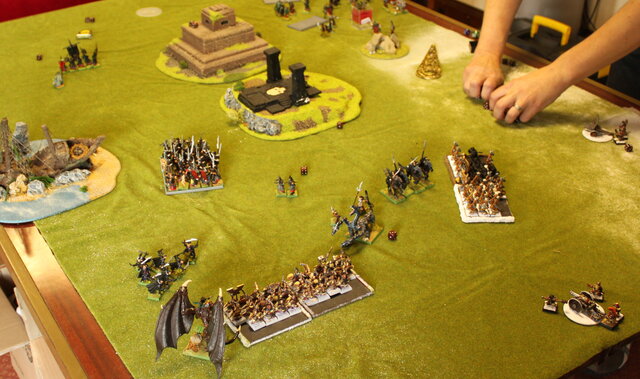
A game of Warhammer Fantasy, by RedCraig, CC BY-SA 2.0, via Wikimedia Commons.

Warhammer 40,000 is a tabletop wargame, where players take turns moving figurines around a battle map, performing attacks and trying to defeat the other player. The game is very crunchy, with a thriving competitive scene. However, lots (most?) of the fans of the hobby never play the game itself: some like to paint the figurines, others play the spin-off video games, and some (like me) are just interested in the lore and novelisations.
Warhammer has a massive amount of lore. There are hundreds of novels, decades of magazines, and 10+ editions of the game with official rules and factions. There’s also a cottage industry of YouTube explainers of that lore (of which Arbitor Ian is the undisputed best), which was my entryway to the hobby.
Grimdark
The thing that initially caught my interest about Warhammer was its aesthetic and tone. Warhammer 40k is “grimdark”: the universe of the 41st millennium is relentlessly bleak and miserable, and every faction in that universe is some degree of evil. There are no good guys in 40k. The protagonist faction is the “Imperium of Man”, a militarised, totalitarian, fascist society with a Catholic/crusades flavoured religious devotion to a (possibly dead) emperor. The main antagonist is Chaos, a demonic faction that includes Hellraiser-style baddies, big-mad-and-red-style baddies, and a few swamp-thing style baddies.
This pessimism facilitates interesting narratives: handled properly, with the right amount of humour and silliness, it can make for textured and witty storytelling, rather than the dreary slog that you might expect. Also, I find the gothic aesthetic of Warhammer compelling. Pure sci-fi settings can leave me feeling cold: I don’t care about super-fancy spaceships that go really fast, or cool guns, or even super-soldiers in power armour. But if that power armour is sacred power armour, and it gets blessed by a pseudo-Catholic slightly occult priest in a gothic cathedral before being donned by a super-soldier crusader in a religious ceremony with tonnes of candles and incense and Latin plainchant in the background, then absolutely sign me up.
Let’s now talk about these books. The Horus Heresy is set in the year 30,000 (ish), 10,000 years before the setting of the main game. It tells the story of the civil war that started the long decline to the miserable world of 40k. Mind you, that long decline wasn’t starting from a utopia: the humans of 30k are still space fascists, they still do genocides, life still sucks for most people. However, things are better than 40k, as far as humans are concerned: the human faction are winning most of their wars, the crusade is going relatively well, and the emperor is walking around and doing stuff in a very emperor-y way. Flavour-wise, the Horus Heresy series has more of a Roman Empire feel than the gothic and religious 40k.
As satire, I do think that the Horus Heresy series basically fails: often, the ease of a good-guys vs bad-guys narrative seems to work just too well for the writers to pass up, so half-hearted gestures towards subtext get steamrolled by an action-packed finale where the space marines crush the baddies to the tune of “The Boys Are Back in Town”.
I don’t want to make it seem like this means these novels are bad, mind you. An action-packed romp is fun! My favourite entries in the series are probably the ones that dispense the most with the “maybe space marines are bad” hangups, because they were enjoyable to read. To the reviews!
Horus Rising (Dan Abnett)
Horus Rising was the first book in the Horus Heresy series, and it was also the first Warhammer book I read. It’s pretty good! There’s nothing earth-shattering here, but it was readable and brisk, and the characters were vivid and varied.
The structure of the Horus Heresy is supposed to follow the long descent into corruption of the eponymous Mr. Heresy himself, Horus Lupercal. When Horus Rising was written, Games Workshop did not know how long the series was going to be: depending on sales, the entire thing might have been wrapped up in a trilogy. This initial plan shows through in the pacing: by the end of Horus Rising, it feels like we’re about a quarter of the way through the entire heresy. In reality, of course, the Horus Heresy series has over fifty novels, so some fans think that the pace of corruption in Horus Rising and False Gods is too fast. I disagree: I think the whole series is pretty bloated (even based on my small sample), and both of the first two entries could have been tightened up.
Dan Abnett is my favourite writer of the Horus Heresy series: his prose is functional and often funny, his characters are well-drawn and likeable, and I especially like the plotting in each of his books. Each book of his that I’ve read includes some plot device or conceit; in Horus Rising, the opening depicts the space marines invading a planet inhabited by a population that thinks that it is the original earth, with its very own emperor and society suspiciously similar to the Imperium. It’s a clever idea, and it works well thematically with the rest of the book.
There is a chunk of filler in the middle: the chapters on the “murder” planet have very little impact on the rest of the plot (other than introducing the Emperor’s Children, which could have been done elsewhere), and they had the effect of making the whole thing feel episodic. I’ve noticed this same issue in a few of Dan Abnett’s other Warhammer books: there often is an act (usually the second-last) that drags, and doesn’t add anything to the rest of the plot, which is otherwise tightly constructed.
Humours
The space marines in Horus Rising love to talk about “humours”: they’re forever describing people as “phlegmatic” or “sanguine”. I thought it was a good bit: they should do more of it in the other books!
There’s quite a bit of gratuitous description of how cool and badass various dudes are, which I would imagine some people might find grating. Myself, I found it entertaining: by the 6th or 7th synonymous description of how tall some burly dude was (he was 8 feet tall, he stood three heads taller than her, he barely came up to his elbow) or how handsome Horus was (there’s a paper to be written on unsexy depictions of handsomeness or muscularity in these books) or how a space marine could train for a bajillion hours straight (he had been sparring for 32 hours, and he was just beginning to sweat), it started to read like a running joke. To enjoy these books, you have to remember to not take them (or yourself) too seriously!
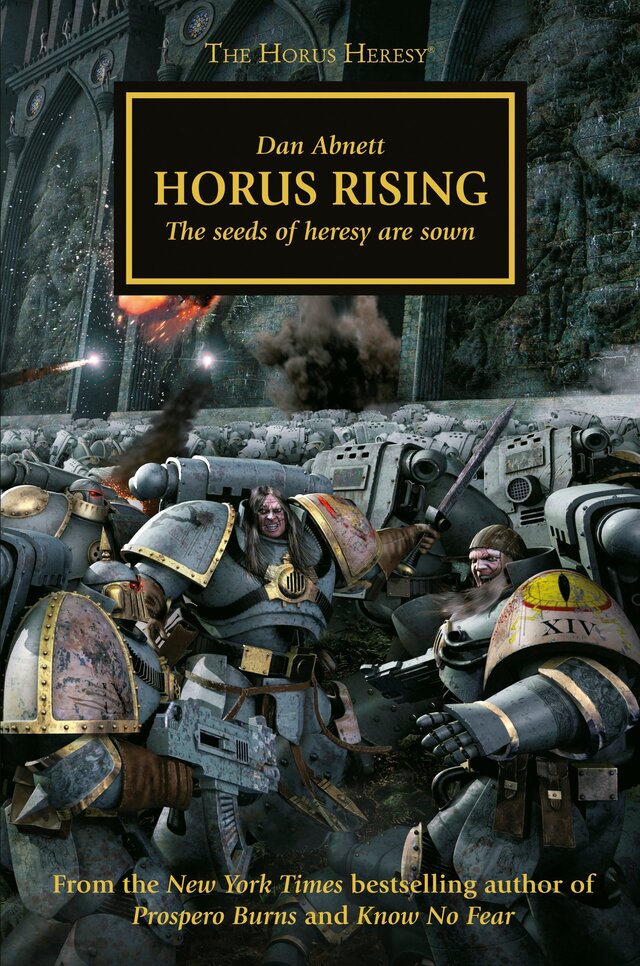
Also: the cover, in my opinion, is one of the worst of the series. My apologies to the artist, but I viscerally dislike it: it looks like bad 3D art from maybe the early 2000s, it’s not evocative of the setting, and why do the two dudes with their helmets off have the shiniest, straightest hair I’ve ever seen? And why is that guy on the right wearing a skullcap?
Verdict
A good intro to the series, but probably my least favourite of Abnett’s entries. Bad cover.
False Gods (Graham McNeill)
False Gods is the second entry in the Horus Heresy series, and it’s my least favourite of the entries that I read. In fact, I disliked it so much that I skipped all of Graham McNeill’s other books. It’s a pity, because this is probably the entry with the most important components of the overarching plot in it.
The story follows the next bit of the fall of Horus (to be honest, Horus is like 98% fallen by the end), so it picks up directly where Horus Rising left off. As a result, there are repeated characters, and the contrast in characterisation between the two books does not do this one any favours. One particularly stark example was Ignace Karkasy, a bohemian writer, who transforms from a snobby but sharp & likeable lush into a boorish creep.
One positive I can say about this entry is that McNeill really seems to revel in the grim and gory, which I liked. We get gross details about servitors, a heap of body-horror, and a few bloody set-pieces that were pleasingly disgusting. We also get a preview of the mid-series big bad, Erebus: McNeill’s version of the first heretic is enjoyably arch and almost campy, if a little one-dimensional.
Verdict
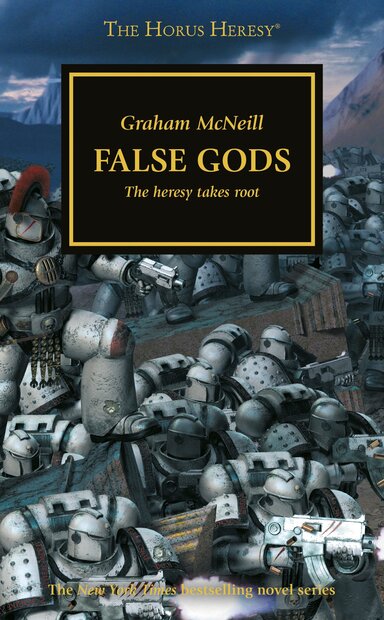
My least favourite. Not a terrible book, but I would skip it. Decent cover!
Legion (Dan Abnett)
We’re jumping forward a good bit here, to a book that tells the story of the “Alpha Legion”, with a plot that could pretty much be a standalone book. Legion is one of the best of the bunch: the world-building is fantastically colourful and textured, and the characters are immediate favourites.
The setting is a desert planet, with an intricately described occupying Imperial army. Too many sci-fi militaries feel like shallow reskins of a handful of overused historical examples (WWII armies, medieval knights, occasionally the Mongols), but the “Geno Five-Two Chiliad” of Legion felt different and exciting. It takes linguistic elements from a diverse set of real-world armies that usually don’t get much attention in sci-fi: “hetman” and “bashaw” are derived from historical ranks in Central and Eastern European militaries, and the Ottoman military system, respectively.
The story is a spy thriller, with John Grammaticus as the international man-of-mystery. I enjoyed his character: he was charismatic and swashbuckling, but also occasionally charmingly gormless and flat-footed.
Apparently, he was too charismatic in this book: after becoming a fan/writer favourite, he was crowbarred into far too many books and stories and eventually became flanderised. The fandom has quite a negative opinion of the character at this point, but as this was my first encounter with him, I hadn’t yet been soured, and I liked him!
Sprinkled in among such a charismatic and varied cast of characters is the contractually-obligated space marine or two. The titular legion is one of the more characterful legions in the series (8-foot-tall power-armour-clad mutants trying to convince the reader they’re masters of espionage, subterfuge, and subtlety), but as I read it became more and more clear that Warhammer books work better the less attention space marines get, and the more focus is put on human characters. Space marines can be compelling, but only when kept in the background, or as a semi-distant threat; as characters they tend to be boring.
The weakest part by far was the ending. I have seen people online complain about power-scaling issues (“character x would never be able to beat character y in a fight”), and also people have complained that the Alpha Legion primarch doesn’t act in a way that’s in line with how they think a super-intelligent primarch would act. I don’t have a lot of respect for those kinds of criticisms. That said, the “twist” to explain the Alpha Legion’s motivation did feel contrived, and more importantly it felt detached from the emotional and thematic core of the earlier three quarters.
Verdict
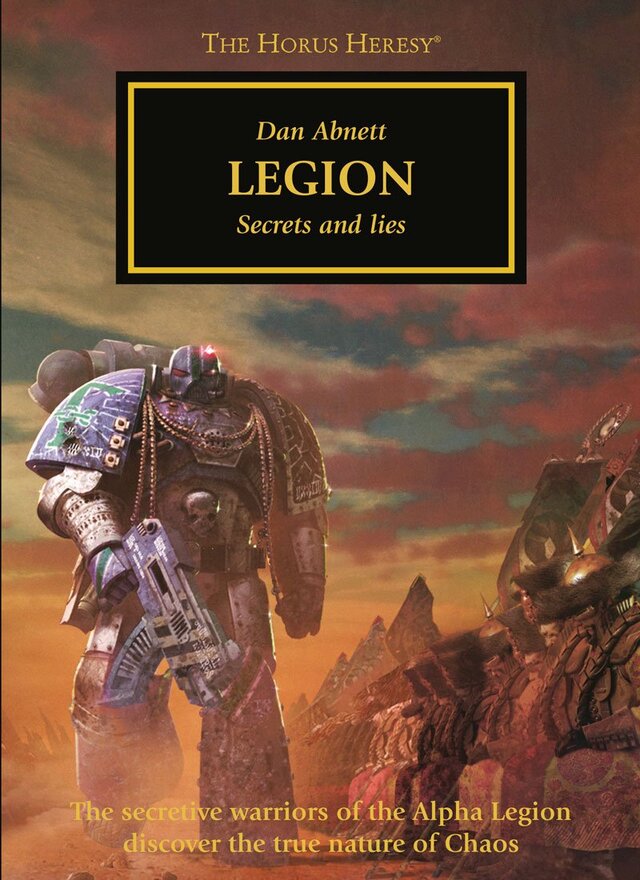
An entertaining and colourful thriller, tied with Know No Fear for my favourite. Also, a great cover!
The First Heretic (Aaron Dembski-Bowden)
The First Heretic is the first book I read that depicted an honest-to-goodness “traitor legion”. These are the “bad guys” (but do remember that everyone here is a bad guy, so these are more the moustache-twirling bad guys, whereas the others are just the self-righteous bad guys). It’s also the only book I read that takes seriously the idea that the whole Imperium is rotten to the core, and not just a “flawed, but fundamentally decent” institution. Dan Abnett’s books often inject the odd bit of “oh, maybe this or that space marine is problematic”, or “ooh, isn’t there an ethical quandary here”, but it usually gets dispensed pretty early on before we’re back to “they’re all just good boys trying their best”.
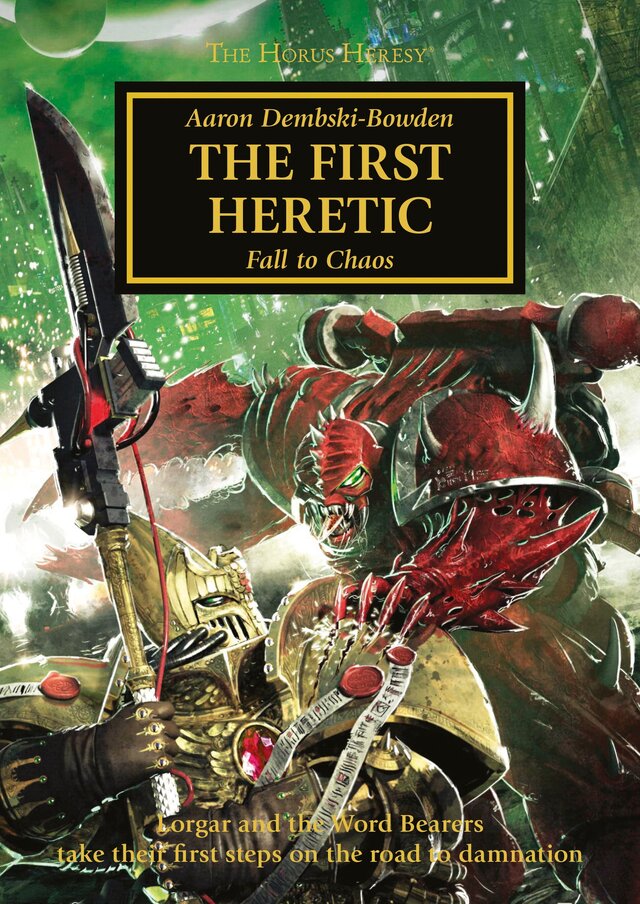
I get the sense that Aaron Dembski-Bowden, on the other hand, really does think that all these guys are bastards. He does a good job at conveying the sliminess and nastiness just underneath the chivalric facade of the space marines.
Another aspect of this book that contrasts with the others I had read is its melodrama and pathos. We spend a lot of time with primarchs, often with them expressing vulnerability, discussing their emotions and insecurities; those scenes feel appropriately larger-than-life. The primarchs are goofy, adolescent, and almost caricatured (not necessarily in a bad way), swinging around big dumb emotions like a battle-axe (or, perhaps… a warhammer?).
Sometimes the writing is a little stodgy or clumsily pretentious, but it kind of works in context. One example that sticks out to me is a conversation between Lorgar (the primarch of the main traitor legion), Kor Phaeron (his adopted abusive father, the sadistic evil guy that even the other evil guys dislike), and Erebus (the mastermind). After a public and humiliating telling-off from the emperor, Lorgar spends a few days in solitude sulking and (literally) self-flagellating, and then has a meeting with these two advisers. I listened to this section on the audiobook, so maybe it was the voice acting that gave me this impression, but I felt like this scene was almost played for laughs: Lorgar comes across like a petulant teenager, while Kor Phaeron and Erebus roll their eyes and try to manage the emotions of this unstable man-baby. An especially funny bit is when Lorgar goes fishing for compliments: he asks his two advisers to list the flaws of all the other primarchs, a request they dutifully oblige (“oh yes sire, Guilliman is very stupid, well met.”, “Indeed sire, an astute observation: Ferrus Manus is an ugly loser, and is very jealous of you.”). Then, Lorgar asks for his own flaw, lower lip trembling, and the fellas practically fall over each other to say “you are too caring sire!”, “yes, your heart bleeds too readily”, “your kindness, oh golden one! Your one flaw is how nice you are”.
Erebus, in contrast, is a hyper-competent stone-cold killer. The events of the Horus Heresy as written imply that Erebus outsmarted and outmanoeuvred every single other individual in the Imperium—including several primarchs and the big E himself—from a position of massive material disadvantage. Forget about Guilliman the master strategist: while he was still reading the morning paper over his cornflakes on his way to the trap on Calth, Erebus had already orchestrated the corruption of two primarchs, and was midway through creating a warp storm that would split the galaxy in half. In this context it’s funny to see him exasperatedly try to deal with Lorgar, who is effectively a nuclear warhead with self-esteem issues.
Verdict
Overall, I liked The First Heretic, and it certainly has more to say than most of the other entries about the themes and the setting, but it wasn’t as fun to read as Legion or Know No Fear. Best cover yet, though!
Prospero Burns (Dan Abnett)
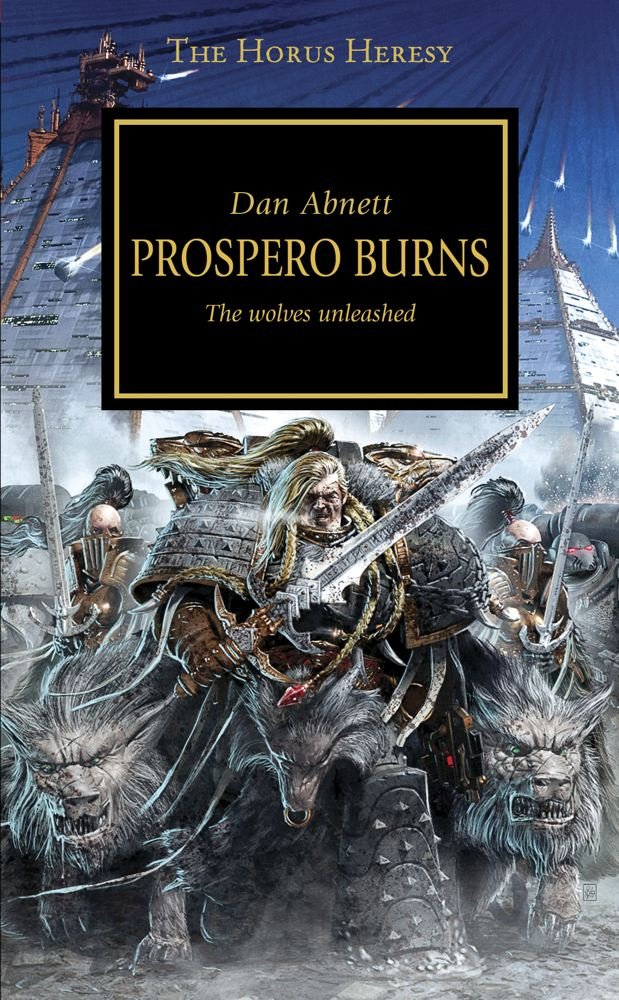
Prospero Burns is told from the perspective of a human character: Kasper Hawser, an archaeologist/historian studying the “Space Wolves” legion. The world-building here was great, with Norse influence that bleeds into the writing style. However, like in Horus Rising, there is one act too many: I did not need or care about the Olamic Quietude, and while important plot points were sprinkled throughout this section it nonetheless felt flabby.
The most memorable aspect of Prospero Burns was its framing device and narrative structure. The book plays around with memory and time: the story is told in a surreal and disjointed way, with flashbacks, and suggestions of unreliable narration/memory. I watched an interview with Dan Abnett, where he explained that he was experiencing grand mal seizures for a year while writing, before being diagnosed and treated for epilepsy. Happily, he says he’s fully seizure-free now, but he describes in the interview symptoms of seizures that I wasn’t aware of: for example, he describes that he would perceive a particular smell a few minutes before a seizure started, well before he would lose consciousness. After the seizure, he described how his memory would be lost from two or three hours before the actual seizure. Then, when he was trying different treatments for his epilepsy, at one stage his seizures were significantly reduced but not completely gone, and they manifested not as a loss of consciousness but instead as a sudden strong feeling of déjà vu or nostalgia. These themes absolutely come through: I don’t want to cheapen Abnett’s writing by saying that all of the thematic memory stuff is because of his seizures (after all, he does like to experiment with narrative devices), but he clearly had the topic “on the mind”, and it makes for an interesting read.
Verdict
Good! Tied for third favourite with The First Heretic, but perhaps too much focus on the space marines. Second-worst cover.
Know No Fear (Dan Abnett)
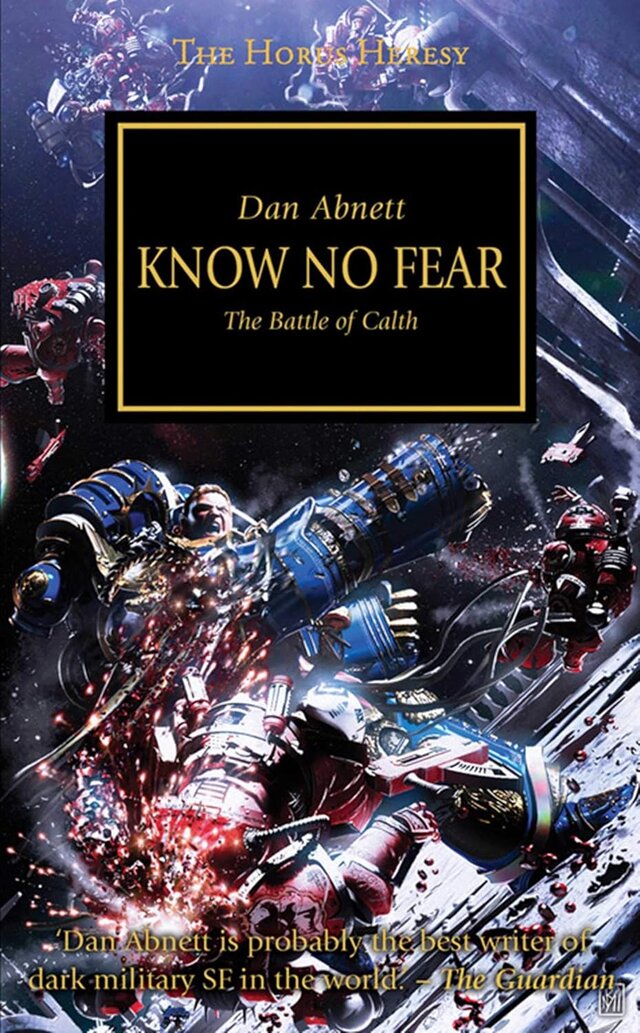
Know No Fear is one big battle. It depicts the Word Bearers’ (Lorgar’s legion) invasion of Calth, a major planet in the Ultramarines’ domain.
Apparently, the Ultramarines are the most popular space marines in Warhammer. They’re the “default” space marine: they don’t have much weird flavour, they don’t have some dark secret, but they’re the largest legion, and the best at fighting. They’re boring, in other words: a bunch of Buzz Lightyears who like to say Imperial slogans, with an easy colour scheme so they’re approachable for beginners.
Know No Fear adds some flavour to the legion, making them out to be war nerds: their primarch, Roboute Guilliman, absolutely loves reading battle reports and devours information about shipping schedules or economic statistics. This is a guy who would chastise you for saying “strategy” when you mean “tactics”, and drops a Clausewitz reference at the first available opportunity (who I know about thanks to Bret Devereaux’s excellent blog).
All of that is set dressing, however, for an absolutely blistering romp, which was tremendous fun to read. It includes a trademark Dan Abnett narrative device: the whole story is told in the present tense, with a ticking clock counting down at the start of each block of prose, 24-style. It turns out that I am a sucker for gimmicks like this: I remember that when I got to the ten-minute mark I was completely gripped, unable to put the book down until I found out what happened at 0.
Verdict
Banger. Tied favourite. Second-best cover of the bunch, also.
The Master of Mankind (Aaron Dembski-Bowden)
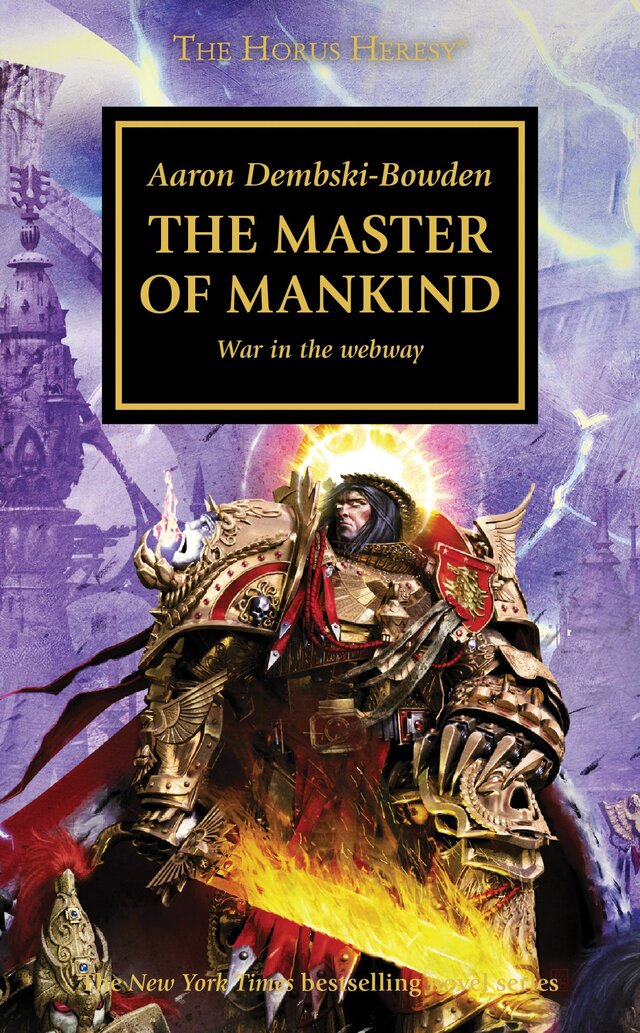
The Master of Mankind was the last of the Heresy books I read, and I didn’t love it. I didn’t quite dislike it, and Dembski-Bowden (like in The First Heretic) presents a different, nastier perspective on the Imperium, but the story as a whole was not as entertaining as most of the other entries. The webway sections in particular were a bit of a slog.
The main thing people know The Master of Mankind for is its emperor content: he’s usually a distant enigma in the rest of the narrative, whereas here he is depicted directly, in conversation with his close advisers. We get some nuggets of insight into how the emperor works: he presents a radically different facade depending on who he’s talking to, changing not just in visual appearance but also disposition and temper. When a high-ranking tech-priest (cyborg) of the Mechanicum interacts with the emperor, the tech-priest perceives him as a cold, calculating machine, who addresses his primarchs by their numbers rather than their names (there are some people online who get annoyed by this scene, because they think it changes the character of the emperor in a way they don’t like. Those people lack reading comprehension skills). Then, in other scenes we see a completely different figure, tailored to the biases and preconceptions of whatever interlocutor the emperor needs to manipulate. In this way, Dembski-Bowden manages to give a bunch of details about the emperor without revealing his inner workings at all: if anything, it takes away some information that we had previously, because it reinforces the idea that people’s perception of him is unreliable.
I did enjoy the Mechanicum characters: Arkhan Land in particular.
Verdict
While the nature of the emperor is important to the wider lore, I just don’t find him terribly interesting as a focal character. That, coupled with the webway bits I didn’t love, meant The Master of Mankind didn’t have much that I was excited about. The cover is fine, but I prefer some of the other depictions of the emperor out there.
So, that’s my review of a few of the Horus Heresy books! I would definitely recommend all of the Dan Abnett entries I reviewed here, and probably The First Heretic as well, if you’re intrigued. You also don’t need to know much about the wider lore to read the books: they’re not particularly hard to follow, and whatever you do, do not read all of them in order.