About three years ago, I started lifting, as a way to rehab some persistent injuries I had developed when doing other sports (rowing, cycling, running, etc.). I have found that there are lots of interesting subjects within the world of lifting, so I thought I’d write about some of them here.
Squatting
My favourite exercise is the squat: that’s the one where you have a barbell on your back (across your shoulders usually), and you complete a rep by bending your knees, dropping your hips, and then standing up again. The “squat simulator” window is a widget that can demonstrate: if you click the “squat” button the stick figure will perform a squat.
One of the things I find interesting about niche hobbies is the variety of differing styles or methodologies that exist in the hobby. In lifting, there’s an ongoing debate (that can get surprisingly heated) about the “right” way to squat. Broadly speaking, the two big camps are the powerlifting-style squat (shown in the Powerlifting window) and the weightlifting (or “Olympic”) style squat.
Powerlifting
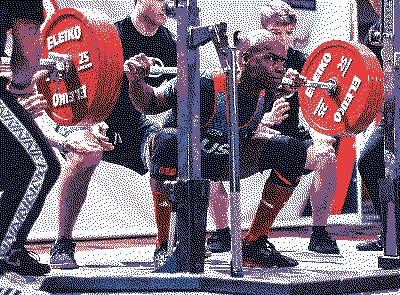
Ken Bray performing a squat at the 2022 Masters World Championships, by Kennethbray, CC BY-SA 4.0, via Wikimedia Commons.

The powerlifting-style squat tends to bend the torso over a lot, minimise knee flexion, and finish with the femur just below parallel. Click here to make the stick figure in the simulator perform a “powerlifting-style” squat. The “weightlifting”-style squat, on the other hand, keeps a relatively upright torso, pushes the knees forward, and bottoms out quite deep, with the hamstrings nearly touching the calves. Click here to see a “weightlifting” style squat.
The reason for these two different styles is largely driven by the constraints of the sports involved. Weightlifting and powerlifting are both strength sports: in each discipline, athletes compete by performing multiple lifts (squat, bench, and deadlift in powerlifting; snatch and clean-and-jerk in weightlifting), where they have three attempts per lift at a maximal weight. The winner is whoever has the largest total across the different lifts.
While athletes in these two sports both squat a lot, notice that only powerlifters have squatting as an actual competition lift: as a result, a powerlifter will generally try to develop the most efficient squat possible, maximising mechanical advantage to perform a movement that just about qualifies as a good squat. In the widget on the left, the lifter gets three white lights if the squat hits “competition depth”; that is, if the lifter’s hips pass below their knees, which is what most powerlifting federations count as a “good squat”. You’ll notice that the powerlifter’s squat only just hits parallel before they stand back up. On top of that, generally speaking people have stronger hip extensors (back and glutes) than knee extensors (quads). A powerlifting squat will tend to minimise knee flexion, letting your back and glutes do more of the work. (Although note that some powerlifters, notably John Haack, do squat with a relatively upright style.)
Weightlifting
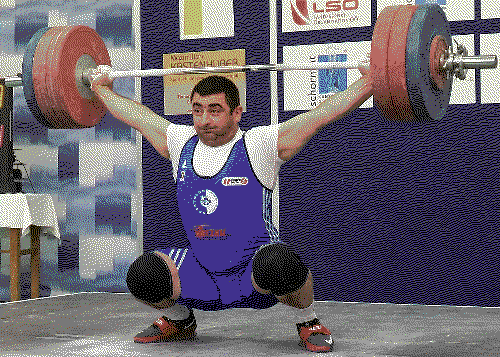
Sargis Martirosjan performing a snatch at the 2017 Austrian Weightlifting Bundesliga, by Isiwal, CC BY-SA 4.0, via Wikimedia Commons.

Weightlifters, on the other hand, use squats solely in training: they tend to prioritise depth and knee flexion, partially to mimic the joint angles found in their actual lifts, and partially to put themselves in mechanically disadvantaged (and “stretched”) positions which—the thinking goes—is better for strength development. Notice that the weightlifter’s squat goes much deeper, and the knee angle is much more acute.
Most people who squat, however, are doing so because they want bigger or stronger legs, not because they compete in a strength sport. Without the hard constraints of competitive lifting, there’s not a lot favouring one style of squat over the other. It’s no great surprise that it’s a topic the internet loves to debate.
In my opinion (and I’m not an expert, and my best squat is 165kg, so that opinion doesn’t count for much), most of the purported differences are overblown: aside from personal preference, I don’t think there’s a really good reason to pursue one style over the other. (for example: in the past, it was occasionally argued that deep knee flexion was bad for your knees. You might have heard the phrase “keep your knees behind your toes” while squatting; this led some people to believe that the powerlifting-style squat was somehow “healthier” or “safer”. This view has largely fallen out of favour among experts.) If you want to read someone who actually knows what they’re talking about, you should check out anything Greg Nuckols has written on squatting or range of motion.
Finally, one of the frustrating things about squatting is that your limb lengths and flexibility can really dictate the style of squat you’re able to do. Personally, I try and do the Olympic-style squat—I think it looks cool, and I want to squat like Clarence—but I’m pretty tall, and tall lifters can find it more difficult to hit depth with an upright torso. Here’s a lifter with unfavourable proportions for weightlifting-style squatting: notice that they find it difficult to even reach depth. There is one cool trick to fix the problems of long-limbed lifters with poor ankle flexibility: heeled shoes (there are specific shoes sold for weightlifting that include a heel and very little padding, often with a fully solid sole). If we give the same lifter heeled shoes notice that they can hit a nice, deep squat no problem. I think some beginner lifters might think that wearing heeled shoes is like training wheels: it’s absolutely not! Most top weightlifters wear them, and if you squat in flat shoes when you don’t have the ankle mobility to hit depth you will learn worse patterns (for an Olympic-style squat).
Lifting is a lot of fun!
When I started lifting I was already really into cycling and running (I was doing some combination of cycling/running/rowing for multiple hours a day, twice a day, five times a week), but after a few months of lifting it quickly took over as my favourite form of exercise. I think a lot of people can be intimidated by lifting, but (in my opinion) it’s a great sport for beginners, and it’s a sport that you can keep doing for years and years.
Old Lifters
Longevity in powerlifting is much better than you might think. If you take a look at the world powerlifting records you’ll see quite a few older lifters. In the male squat records (equipped) we see 2 lifters in their 20s, 4 in their 30s, and 2 in their 40s. In the female squat records (also equipped), we have 5 lifters in their 20s, 2 in their 30s, and one 49-year-old lifter. These athletes are all the best in the world at their respective lifts: these are not people who are still “pretty good” at lifting despite their age; these are people who are reaching the peak of their sport in their 40s.
Bear in mind these records are the equipped records: equipped powerlifting is a discipline where athletes are permitted to wear special clothing and equipment while lifting. This equipment allows them to lift more weight, but it also is technically quite challenging to use. The equipped records do tend to skew older, but I don’t think this has anything to do with the technical nature of the discipline itself, rather it’s more to do with the fact that equipped lifting was much more fashionable in the past, and newer lifters are more likely to get into unequipped (also called “raw”) lifting.
People seem to keep their strength as they age in a way that they don’t maintain their speed: on top of that, building strength can take a long time, much longer than it takes to build a similar level of cardiovascular fitness. These things combine to make the sport especially good for middle-aged people: I think if you start lifting in your 20s, you can expect to peak in your 30s or 40s.
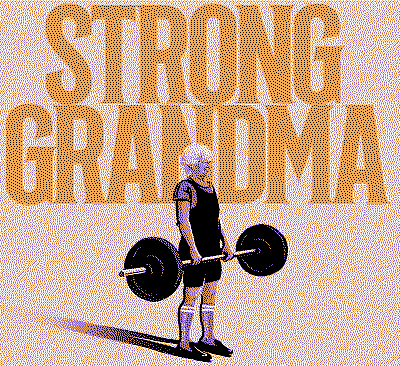
I would also highly recommend the short documentary Strong Grandma (available for free on YouTube) on a 95-year-old powerlifter, from the New Yorker.
Lifting is Forgiving
A big contrast I noticed between lifting and cardio exercise is how forgiving lifting is. I mean this in the training sense: I found that, after about six months of cycling training, if I wanted to make decent improvements I’d have to increase my training hours by a lot, and if I ever took more than a week’s break from training I would lose a lot of the fitness I had built up.
In contrast, you can make strength gains on surprisingly little training. That link is to a summary of a meta-analysis that showed intermediate lifters were able to improve their 1RM with a single set (taken close to failure) at 70-85% of their 1RM 2-3 times a week. Including a warm-up, that’s about 30 minutes of training a week! (per lift)
The other nice thing about lifting is that gains come and go slowly. If you stop training entirely, you can expect to keep all of your 1RM strength for up to a month. (yes, basically all of my links are to Stronger by Science. In my opinion, they provide the best information on lifting out there, and they have the most normal internet presence, in contrast with other groups.) Muscle memory is also a well-documented phenomenon: if you do detrain significantly, it will take you much less time to build back up your strength than it did to develop it in the first place.
While it might seem like a downside, I actually like that strength builds up slowly: when I was cycling, I got within 20 watts of my all-time-best FTP after about 6 months of training. That’s exciting for those six months, but a little demotivating if I want to keep cycling as a lifelong hobby. In contrast, I’ve been lifting for 2-3 years and I haven’t seen a serious plateau yet.
There’s Not Much Science on “Good Form”
When I started lifting, I was obsessed for a while about “proper form”. I picked up occasional minor aches and pains, and I thought that each one of them was down to some technical failure in a lift: my shoulder pain was because of my arm position in bench press, or my back pain was due to rounding in the deadlift.
It turns out that there’s actually not very good evidence out there on what causes injuries, or how to prevent them. It’s a pretty well studied area, but gathering evidence is difficult. (injuries are rare, and take a long time to show up. It’s much easier, for example, to test if some supplement gives an immediate performance improvement than it is to test if some small technical change reduces injury rates over several years.) I find that people online are far too certain about certain aspects of form or technique causing or preventing injury.
“Bad” Form
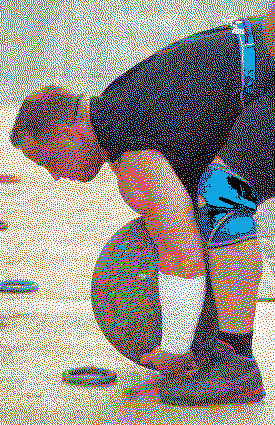
The Atlas Stones at the Strongman Champions League in Gibraltar, by Marcos Moreno, CC BY 2.0, via Wikimedia Commons.

As an example, you probably have heard the mantra “lift with your knees and not your back”. This is pretty much assumed as good advice in general: people think that if you use your back while lifting, especially if you have some lumbar flexion, you’re basically asking for an injury. Except—this is not a consensus view among experts, at all. I’m not saying there’s no evidence for this idea, and I should emphasise that I’m not an expert, so I can’t really judge the quality of the linked review, but I do think that the expert review comes to a surprisingly different conclusion to the lay consensus.
In powerlifting (and weightlifting) in particular, there’s not much good evidence on form or technique and injury at all. The most recent review I found on injury rates didn’t report any association between different techniques (but it did happily show that injury rates were quite low). This narrative review on injuries in powerlifting noted the lack of hard evidence on any particular technique contributing to injury. There are studies showing that different techniques will cause different forces on the joints; but that’s a far cry from strong evidence that a particular technique will result in less actual injury.
And all of this evidence is just to see if form or technique is even associated with injury. We haven’t even got to the question of which technique you should employ if you do want to reduce injury: ask five coaches for the “proper” deadlift technique, and you’ll get six different answers.
All of this is to say, I had a much better time with lifting when I stopped obsessing over “proper form”, or thinking that every ache and pain was a signal I needed to change my technique. For me, a bad night’s sleep is a better predictor of injury than back rounding, and injury management has been done best by reducing the volume for a while and then building it back up. Also, if you’ll allow me to do a small PSA, please don’t correct people in the gym on their “form”. They might be doing something you don’t understand, and you might be mistaken about the safety of their movement.